
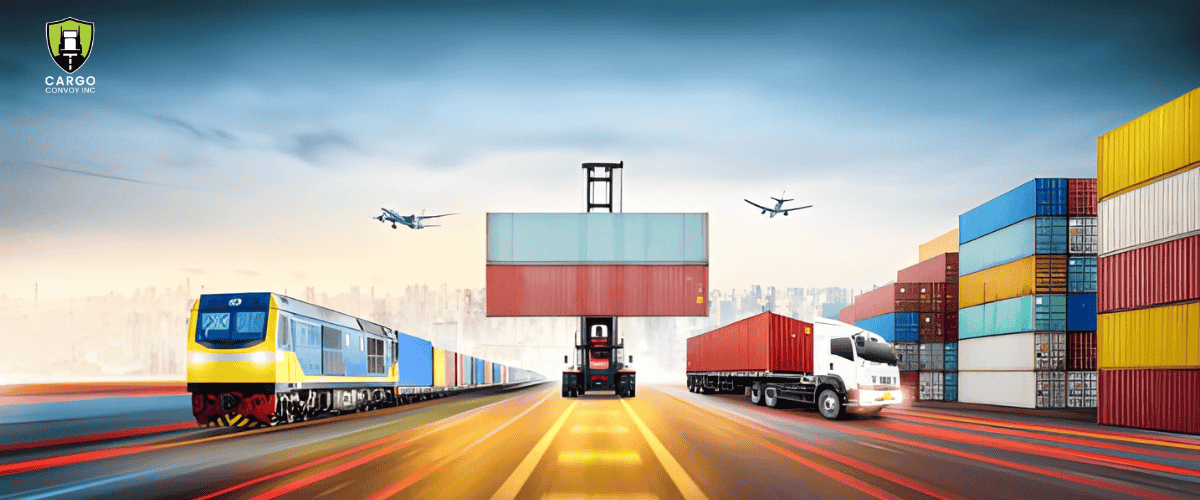
In the evolving global economy, demand for cost-effective, efficient and sustainable logistics options is growing. The organization and supply-chain managers are also now turning to intermodal transportation, which is a combination of rail, road, and sea if required, for the cross-items across lengthy distances with minimal cost. This transformation also includes rail freight as a mode of transport that presents interconnectivity, remarkable capacity and environmental benefits as well. For the provider of logistics services like Cargo Convoy, leveraging the strengths of rail may help unlock new tiers of efficiency and connectivity.
Intermodal transportation refers to the movement of freight using a combination of modes of transport, normally a combination of rail, truck, and occasionally ship or barge, except when desiring to unpack and re-pack the cargo when switching modes. As per the logistics professionals, this approach depends on containerization, where standardized ISO containers or trailers are sealed during the journey, instead it is carried or not carried by sea, road, or rail. In the built-in model, rail plays an important role. While vehicles manage the “first mile” and “last mile”, handing over items from factories or warehouses to rail terminals and then from remaining terminals to stop destinations, rail handles the long-haul segments. By combining the flexibility of vans with the power and efficiency of trains, intermodal transport ensures cargo moves smoothly from origin to destination, overcoming geographical, infrastructural, or logistical constraints.

One of the predominant motives why rail freight remains the spine of intermodal transport is its unmatched potential and efficiency. The single freight train may drag huge loads, something that can take dozens or hundreds of vehicles to replicate. This makes rail appropriate for high-volume freight, bulk commodities, and giant shipments. However, when it comes to long-distance freight, rail is low-cost and extra fuel-efficient compared to steel transport. For instance, in contrast to trucks, rail devour much less gas per ton-mile that reduces emissions of carbon and decreases costs of transportation.
Reliability plays another important role in rail freight; dedicated signaling systems, rail infrastructure, terminals, and tracks are engineered for popular runs and heavy masses. This type of infrastructure is more predictable, stable, and less susceptible to delay than avenue transport. That can be through unfavourable weather, site visitor congestion, or driver shortages. For the logistics firm offering Rail Freight Transport Services or Freight Rail Services, this dynamic can foster a reliable spine of supply-chain operations like constant transit schedules, excessive capacity, and decreased fee per ton.
A main benefit of combining rail with other modes like road or sea is allows for seamless connectivity in the assorted geographic areas and lengthy distances. Rail also performs an essential function for linking seaports with inland manufacturing hubs or distribution facilities. After cargo reaches the seaport through the use of a ship, trains can accelerate cargo flow to hinterlands, transport containers inland, and decrease traffic congestion around ports.
This connectivity can foster the effectiveness of the supply chain in different ways:
For the carrier issuer such as Cargo Convoy, supplying built-in options of Freight Rail Service & Supply Chain has the potential for consumers who may offer an advantage from this end-to-end connectivity, from port/yard to warehouse for remaining shipping, with minimal friction. As alternatives grows, intermodal structures can take in extra volumes, without increasing environmental burden or proportionally growing price.
In an age when sustainability is no longer non-obligatory, however essential, rail-backed intermodal transport stands out. Rail is extensively extra energy-efficient than street transport, consuming a long way less gasoline per ton-mile, which dramatically reduces greenhouse gas (GHG) emissions. This gasoline efficiency and decreased emissions aren’t solely environmental advantages. Intermodal transport, with the aid of moving freight off crowded highways, helps minimize visitor congestion and wear-and-tear on highway infrastructure, which results in fewer street repairs, much less noise pollution, and decreases environmental degradation around transport corridors.
If reviewed from a fee perspective, the scale of economies presented by using a way of rail translates to giant financial savings for the shippers. Moving large quantities of cargo by means of rail regularly costs less per ton-mile than by road, mainly in the long-distance legs. The logistics carriers like Cargo Convoy may leverage these advantages to offer cost-effective, green, or efficient Rail Freight Services and Rail Freight Transport Services which meet the requirements of the contemporary supply chain.
As international change volumes increase and grant chains turn out to be more complicated and geographically dispersed, the position of freight rail in intermodal logistics is set to turn out to be increasingly more critical.
First, rail’s scalability makes it best for future growth. Trains can haul substantially greater freight per day trip than trucks; with advances in container standardization and applied sciences like double-stack rail motors (where containers are stacked two-high on specialized railcars), potential per educate doubles, besides requiring a longer train.
Second, rail intermodal logistics affords resilience. By giving shippers more than one option, rail, road, sea, supply chains are much less inclined to disruptions like gasoline rate spikes, driver shortages, traffic congestion, or weather-related delays. Intermodal logistics spreads threat throughout modes and partners, making the whole supply chain greater robust.
Third, as demand for sustainable logistics grows worldwide, fueled by environmental regulations, company sustainability goals, and customer expectations, rail freight affords a clear, aggressive edge. Lower emissions, fewer vans on roads, and greater environmentally friendly electricity use make rail-backed intermodal options mainly attractive.
For Cargo Convoy, embracing this rail-centric intermodal mannequin capacity, the potential to supply complete Freight Rail Services, Freight Rail Transport Services, and Freight Rail Service & Supply Chain options that are efficient, cost-effective, scalable, and sustainable. By turning into the bridge between manufacturers, ports, inland hubs, and end-customers, combining rail, road, and, as needed, maritime links, Cargo Convoy can function itself as a cutting-edge logistics associate tuned to future demands.
In this fast-paced international supply chain ecosystem, rail freight has not become an alternative that acts as an important pillar of scalable, sustainable, and efficient logistics. By intermodal transportation, rail unlocks benefits that single-mode or road-only cannot match: seamless connectivity, huge capacity, gas and price efficiency, environmental sustainability, and increased reliability throughout modes. For logistics carriers such as Cargo Convoy, leveraging Rail Freight Services and combining them with sea and air transport offers a compelling fee proposition of a flexible, end-to-end, and future-ready supply-chain solution. Adopting this model these days not only can provide on-the-spot good points in effectiveness and price financial savings, but also positions corporations to thrive in the complicated grant chains of tomorrow.

30 March, 2026
27 March, 2026

24 March, 2026

20 March, 2026
16 March, 2026